Naturalization in Taiwan
By Elliott Jones50 min read
Last updated

Naturalization in Taiwan is the Ministry of the Interior (MOI)-administered process through which a foreign national or stateless person acquires Republic of China (ROC) nationality.[1][2] The ordinary route generally requires at least 183 days of legal residence in each of five consecutive years, as well as legal capacity, good conduct, financial self-sufficiency, and basic language and civic knowledge; some spouses, family members, minors, high-level professionals, and people with special contributions may use different rules.[1] Naturalization does not itself establish household registration: a newly naturalized person is an NWOHR and must complete separate residence and settlement procedures before becoming eligible for a National Identification Card.[5][6] Unless an exemption applies, proof of loss of previous nationality is required within one year after naturalization.[1]
Requirements
The general naturalization requirements are established in Article 3 of the Nationality Act, under which a foreign national or stateless person may apply for naturalization if the following requirements are met:[1][2]
- Has domicile in Taiwan
- Has had at least 183 days of legal residence in Taiwan in each year for at least five consecutive years
- Has legal capacity under both ROC law and the law of their country of nationality
- Has no bad conduct and no criminal-case record appearing on the police criminal record certificate
- Has sufficient property or professional skills to be self-supporting or otherwise has a secure livelihood
- Has basic language ability and basic knowledge of the rights and obligations of ROC nationals
Exceptions
The Nationality Act provides alternative naturalization routes for applicants with specified family ties to the ROC, particular birth or residence connections, high-level professional qualifications, special contributions, and accompanying minor children. Unless a provision expressly removes a requirement, applicants under Articles 4 and 5 remain subject to the applicable conditions in Article 3.[11]
Spouses and specified family connections (Article 4(1))
A foreign national or stateless person currently domiciled in ROC territory who has had legal residence in Taiwan for at least 183 days in each year for three consecutive years may apply for naturalization under Article 4(1). Except where stated otherwise, the applicant must still meet the Article 3 requirements concerning legal capacity, conduct, financial self-sufficiency, and language and civic knowledge.[11]
A person married to an ROC national is exempt from the property or self-support requirement, but must meet the other applicable Article 3 requirements.[11]
The same three-year residence route is also available to a person who:
- Divorced an ROC national because of domestic violence and has not remarried;
- Is the unremarried surviving spouse of an ROC national and remains in contact with the deceased spouse’s family members, unless the marriage had lasted at least two years before the spouse’s death;
- Supports, exercises rights and obligations concerning, or meets and interacts with their ROC-national child who is legally incompetent or has limited legal competence;
- Has a parent who is or was an ROC national;
- Was adopted by an ROC national;
- Was born in Taiwan; or
- Is the guardian or assistant of an ROC national.[11][12]
Unmarried minors (Article 4(2))
An unmarried minor who has legally resided in Taiwan for fewer than three years may apply for naturalization if a parent or adoptive parent is an ROC national, or if the minor is under the guardianship of a social-welfare authority or institution. Such applicants need not meet the ordinary requirements concerning legal capacity, financial self-sufficiency, or language and civic-knowledge proficiency; the statutory conduct requirement is not removed.[11][12]
Birth and long-residence routes (Article 5(1)(1)–(2))
Article 5 also permits naturalization, without the ordinary five-year/183-days-per-year requirement, for an applicant currently domiciled in ROC territory who was born in Taiwan and whose father or mother was also born in Taiwan. The applicant must nevertheless meet the Article 3 requirements concerning legal capacity, conduct, financial self-sufficiency, and language and civic knowledge.[11]
An applicant currently domiciled in ROC territory who has legally resided in Taiwan for at least ten consecutive years may likewise apply under Article 5. This route has no annual 183-day residence threshold, but the other Article 3 requirements continue to apply.[11][12]
High-level professionals (Article 5(1)(3))
A high-level professional currently domiciled in ROC territory, recommended by the competent central authority, found to have contributed to the interests of the ROC, and approved through the statutory review process may apply for naturalization after either at least 183 days of legal residence in each year for two consecutive years or at least five consecutive years of legal residence. The applicant must still meet the Article 3 requirements other than its ordinary five-year residence requirement.[11][13]
High-level professionals naturalized under this provision are also exempt from the usual requirement to submit proof of loss of their original nationality.[11]
Special contributions to the ROC (Article 6)
A foreign national or stateless person who has made special contributions to the ROC may apply for naturalization without meeting the requirements in Article 3. Permission is granted by the Ministry of the Interior following approval by the Executive Yuan, and successful applicants are exempt from the nationality-permit certificate fee.[11]
Persons naturalized under Article 6 are exempt from the requirement to submit proof of loss of their original nationality.[11]
Accompanying minor children (Article 7)
An unmarried child under 18 of a person applying for naturalization may apply for naturalization concurrently with that parent. The Enforcement Rules exempt such accompanying minors from submitting evidence of financial self-sufficiency or of language and civic-knowledge proficiency.[11][12]
Language and civic-knowledge assessment
The regulations provide less demanding ways to demonstrate the language and civic-knowledge requirement for applicants under Article 4(1) and Article 5. Applicants may meet the requirement through study at a domestic school, approved government educational programmes, or the naturalization test. The required programme hours and test pass marks are lower for Article 4 and Article 5 applicants than for ordinary Article 3 applicants. For applicants aged 65 or over under Article 3, Article 4(1), or Article 5, the standards provide a 72-hour programme threshold or a test pass mark of 50.[14]
Process
A foreign national who is granted naturalization acquires ROC nationality on the date that the MOI grants permission. Establishing household registration is a subsequent process governed principally by the Immigration Act and Household Registration Act; until that process is completed, a newly naturalized person is a national without household registration (NWOHR).[1][6][5]
Application and review
An application for naturalization is made personally by the applicant or their legal representative and is filed at the household registration office (HHRO) responsible for the applicant’s place of residence. The application is examined by the HHRO and forwarded through the relevant municipal, county or city government to the MOI, which has final authority to approve naturalization. If an application or its supporting documents are deficient but the matter can be corrected, the applicant must be given a period in which to make the correction; the application is rejected if the required correction is not made within that period.[2]
As part of the review, the household registration authorities verify information concerning the applicant’s period of residence, dates of entry and departure, domestic criminal record and, where relevant, household-registration information concerning a spouse, parent, adoptive parent, guardian or other person on whom the application is based. The municipal, county or city government conducts a further examination before forwarding the application to the MOI for a decision. Documents issued outside Taiwan are subject to authentication requirements, and documents written in a foreign language must generally be accompanied by an authenticated or notarized Chinese translation.[2]
If the MOI approves the application, it issues a Certificate of Naturalization.[2] The central government’s service portal lists a standard processing period of 30 days for nationality-change applications.[15]
Loss of previous nationality
Except where an exemption applies, a foreign national who naturalizes must submit evidence that they have lost their previous nationality within one year after the MOI grants naturalization. Where the law of the applicant’s previous country permits renunciation only after a particular age is reached, the one-year period runs from the date on which the person reaches that age. Until that evidence is submitted, the MOI must not approve the person’s settlement in Taiwan.[1][2]
This requirement operates after naturalization: an applicant therefore becomes an ROC national before completing the loss of their previous nationality. The current sequence dates from reforms enacted in 2016. Under the previous system, loss of the applicant’s former nationality generally had to be completed before final naturalization; the MOI said there had been cases in which applicants were subsequently unsuccessful in obtaining ROC nationality and were left stateless. The 2016 amendments instead allowed applicants to provide evidence of loss of their former nationality within one year after naturalization.[3] The renunciation requirement and its relationship with statelessness among migrant spouses has also been examined in academic research.[7]
The requirement does not apply to persons naturalized as qualifying high-level professionals under Article 5 of the Nationality Act, persons naturalized for making special contributions to the ROC under Article 6, or persons who are unable to obtain evidence of loss of nationality for reasons that are not attributable to them.[1]
Extensions are permitted where the applicant is unable to complete the loss-of-nationality procedure because of legal or administrative restrictions imposed by their country of nationality.[1] An applicant seeking such an extension must generally apply at least 30 days before the original deadline and provide evidence that they have applied to the authorities of their country of nationality for loss of nationality.[16]
If a person who is required to provide evidence of loss of nationality fails to do so within the prescribed or extended period, the MOI must revoke the permission for naturalization.[1]
Residence, settlement and household registration
Acquisition of ROC nationality does not by itself establish household registration. A newly naturalized NWOHR may apply to the National Immigration Agency (NIA) for permission to reside in Taiwan under the Immigration Act.[1][5]
For an ordinary naturalized national, the NIA may issue a Taiwan Area Resident Certificate (TARC) (臺灣地區居留證) following approval of the residence application. NIA guidance requires naturalized applicants to provide documents including the naturalization approval certificate, their Alien Resident Certificate (ARC) and evidence of their place of residence. Different documentary requirements apply to persons naturalized as high-level professionals, persons who have made special contributions and certain stateless persons.[17]
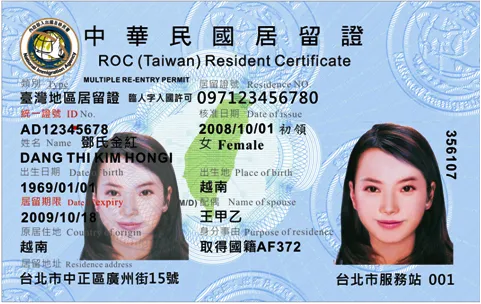
Residence as an NWOHR is legally distinct from settlement (定居), the immigration status that precedes establishment of household registration.[5] An ordinary naturalized national residing in Taiwan under Article 9, paragraph 1, subparagraph 3 of the Immigration Act may generally apply for settlement after meeting one of the following residence periods:[5]
- Resided in Taiwan continuously for one year and been present for at least 335 days during that year
- Resided in Taiwan for two consecutive years and been present for at least 270 days in each year
- Resided in Taiwan for five consecutive years and been present for at least 183 days in each year
The person must continue to satisfy the basis on which residence was granted when applying for settlement. Persons permitted to reside on the basis of having made special contributions to Taiwan or being high-level professionals are exempt from the minimum period of residence otherwise required before applying for settlement.[5]
Applications for settlement are submitted to the NIA. Once an application has been approved, the NIA issues a Taiwan Area Permanent Residence Certificate (TAPRC) (臺灣地區定居證),[18] not to be confused with an Alien Permanent Residence Certificate (APRC). A person granted settlement is required to complete initial household registration at the HHRO for their intended place of registration within 30 days; the NIA may terminate the settlement permission if the registration is not completed within that period. A person with household registration aged 14 or over must apply for an initial National Identification Card; one under 14 may also apply.[6]
The overall procedure for an ordinary applicant can therefore involve three distinct changes of legal status: from a foreign national to an ROC national through naturalization; from a newly naturalized NWOHR to a resident NWOHR under the Immigration Act; and, following permission for settlement and initial household registration, to an ROC national with household registration.[1][6][5]
Revocation of naturalization
Article 19 allows revocation of a naturalization approval that did not comply with the Nationality Act. Three questions matter: what was wrong with the approval, how long the MOI has to revoke it, and what review must happen first. In an ordinary Article 19 case, the MOI faces both a two-year limit after learning of the non-compliance and a five-year limit after naturalization took effect; the MOI must act before either period runs out.[20]
Grounds for revocation
Revocation under Article 19 requires a legal defect in the original approval; something the person did later is not enough by itself.[20] MOI application guidance identifies potentially relevant requirements such as residence, legal capacity, conduct, criminal-case records and financial self-sufficiency.[22] Article 9 separately requires revocation when a person who must provide proof of loss of previous nationality fails to do so within the applicable period; it also provides extensions and exemptions, discussed under loss of previous nationality.[1]
Deadline for revoking a naturalization approval
For an ordinary Article 19 revocation, both time limits apply: the MOI must exercise its revocation power within two years after learning of the non-compliance and no more than five years after naturalization took effect. The MOI must act before either period runs out. These are not alternative periods: five years to discover a problem does not produce another two years to act.[20] The statutory trigger for the first period is the MOI learning of the non-compliance. It is not automatically the date of an offence, complaint, investigation or conviction.[20]
Under Article 8, nationality is acquired on the date the MOI approves naturalization. That is the starting point for the five-year outside limit, rather than later collection of a certificate, passport issue, settlement, household registration or receipt of an identity card.[54] The following simplified illustrations assume an ordinary case and no applicable statutory exception; they show the interaction of the periods, not actual cases or precise day-counting deadlines.[20]
| When the MOI learns of the non-compliance | Time left to revoke under the ordinary Article 19 rule |
|---|---|
| One year after naturalization | The two-year period expires three years after naturalization. |
| Four years after naturalization | The five-year outside limit leaves only one year. |
| Four years and six months after naturalization | Only six months remain before the five-year outside limit. |
| Six years after naturalization | The ordinary five-year revocation period has already expired. |
Opening an investigation does not, by itself, appear in Article 19 as a replacement for either deadline. The examples do not address any case-specific dispute over precisely when the MOI learned of non-compliance.[20] In 2018, the MOI defended retaining the five-year period on the basis that obtaining concrete evidence through judicial proceedings can take more than two years; that was the ministry’s policy explanation, not an additional time-limit rule.[23]
Later findings about conduct before naturalization
What if someone is convicted after approval for conduct that occurred before it, when no conviction existed at approval? There are two separate questions: whether the original approval failed an applicable eligibility condition, and whether revocation remains within time. For routes subject to Article 3’s conduct condition, the Act requires both no bad conduct and no criminal-case record on the police criminal record certificate. Neither condition can simply be reduced to “no previous convictions”.[55]
The current Regulations Governing Determination of No Bad Conduct for Naturalization identify particular disqualifying circumstances, qualifications and routes to a favourable determination. They cover specified criminal dispositions and other conduct; an allegation that someone “broke a law” is not itself the regulatory test.[56] Article 6 of those conduct regulations says that, for a criminal defendant whose case is under investigation or trial, the conduct determination must await the relevant final non-prosecution decision, deferred-prosecution disposition or judgment. This is distinct from Article 6 of the Nationality Act, which concerns special contributions.[56]
A later conviction does not automatically establish that the approval was unlawful when made, nor does a clean certificate at approval conclusively settle every conduct issue. The answer depends on the alleged conduct, whether proceedings were pending, the date and terms of approval, the eventual disposition, the eligibility rules applicable to that route and the MOI’s relevant knowledge. This is an interpretation of how Articles 3 and 19 and the conduct regulations interact; the sources cited here do not establish a general holding for this precise hypothetical.[55][56][20] If an ordinary revocation is proposed six years after approval, it encounters Article 19’s five-year outside limit even if the conviction came later. The specific statutory exceptions below must be assessed separately; a conviction does not itself restart the five-year period.[20]
Exceptions to the time limits
Article 19 excludes revocation under Article 9(1) from its ordinary deadline provision. This concerns failure to supply required proof of loss of previous nationality within the applicable period, taking account of Article 9’s extensions and exemptions. It does not mean every question involving dual nationality falls outside the ordinary limits.[20][1]
The other express deadline exception requires a final court judgment establishing that ROC nationality was obtained through a collusive sham marriage or adoption. Article 19 does not extend this exception to every false statement, fraud allegation or criminal conviction. The MOI has explained that a report or allegation alone does not satisfy the court-judgment requirement.[20][23]
Review procedure and its separate exceptions
Before an Article 19 revocation, the MOI must ordinarily convene a review panel and give the person an opportunity to state their views. The panel has 11–13 members: government representatives, impartial members of the public, and scholars or experts. At least half must be from the latter two groups, and neither gender may account for less than one-third.[20][57]
The directions provide an opportunity to attend and speak, or to submit written views if unable to attend. Where necessary, the panel may invite representatives or assistants, interpreters, witnesses, relevant officials and other attendees with panel consent. The person may submit supporting material, and the MOI must notify the review result in writing. The invitation of additional attendees is conditional; it is not an unrestricted personal power to summon witnesses.[57]
Article 19 makes two exceptions to this panel-and-response requirement: a determination that the person already possesses ROC nationality under Article 2 of the Nationality Act (國籍法), and the final-court-judgment sham-marriage or adoption situation described above.[20][21] Article 2 lists nationality through a parent at birth, the specified case of birth after an ROC-national parent’s death, birth in ROC territory when both parents are unknown or stateless, and naturalization. Its parent-based rules also have a transitional provision for people under 20 when the 9 February 2000 amendment took effect.[58]
As a hypothetical illustration based on reading Articles 2, 3 and 19 together, someone who already acquired and retained ROC nationality through a parent might mistakenly have been processed as a foreign national applying to naturalize. Cancelling that unnecessary approval is conceptually different from extinguishing nationality that exists independently of it. The statute does not narrate this example, and Article 2’s inclusion of naturalization does not exempt every naturalized person from review.[58][55][20] The Article 2 exception concerns the requirement to convene a review panel and provide an opportunity to state views. It does not itself remove the ordinary revocation time limits.[20]
| Situation | Time limits | Review panel and opportunity to state views |
|---|---|---|
| Ordinary Article 19 non-compliance | Both the two-year knowledge limit and five-year outside limit apply. | Required. |
| Revocation under Article 9(1) for missing required proof of loss of previous nationality | Excluded from Article 19’s ordinary deadline provision. | Article 19 does not list this as a panel exception. |
| Determination that the person already possesses nationality under Article 2 | No deadline exception stated for this reason. | Express exception to the panel-and-response requirement. |
| Final court judgment establishing nationality obtained through collusive sham marriage or adoption | Express exception to both ordinary limits. | Express exception to the panel-and-response requirement. |
These columns reflect separate paragraphs of Article 19; an exception in one does not create an exception in the other.[20][21]
In 2018, the MOI stated that a person whose naturalization permission had been revoked could remain in Taiwan while seeking restoration of their original nationality, and could apply to naturalize again if they later met the statutory requirements.[23]
Reported cases
In 2013, the Ministry of the Interior revoked the naturalization permission of a Vietnamese woman after finding that, before her 2009 naturalization, she had engaged in an extramarital relationship and had two daughters with another man. The ministry relied on the then-applicable requirement that applicants be of “upright conduct” (品行端正). In December 2013, the Taipei High Administrative Court dismissed her challenge to the revocation.[25][26] This case applied an earlier conduct standard and does not establish how the current conduct regulations would apply to another case.
Legal effects
Electoral rights
Naturalization alone does not immediately make a newly naturalized NWOHR eligible to vote. Under the Public Officials Election and Recall Act, electoral residence is determined by household-registration data, and electoral rolls are compiled from household-registration records. A naturalized national must therefore establish household registration and satisfy the other statutory voting requirements before becoming eligible to vote.[27]
Eligibility for public office
Naturalized nationals are subject to restrictions on holding certain public offices. Article 10 of the Nationality Act provides that a naturalized foreign national or stateless person may not hold a specified range of senior or elected offices, including president or vice president, legislator, premier or vice premier, senior positions in the five Yuans, deputy minister, ambassador, general officer in the armed forces and elected local-government office.[28] These restrictions generally cease ten years after the date of naturalization, unless another law provides otherwise.[29]
The ten-year period is also reflected in electoral legislation. The Public Officials Election and Recall Act provides that a person whose ROC nationality was acquired through naturalization at least ten years before an election may register as a candidate for public office, provided that the person otherwise satisfies the applicable candidacy requirements.[30] A separate and stricter rule applies to the presidency and vice presidency. Article 20 of the Presidential and Vice Presidential Election and Recall Act provides that persons whose ROC nationality was acquired through naturalization may not register as candidates for president or vice president; unlike the general restriction in Article 10 of the Nationality Act, this provision contains no ten-year exception.[31]
Policy and academic debate
Taiwan’s naturalization system has been the subject of academic debate concerning the integration of immigrants, the treatment of foreign spouses, access to dual nationality, gender and class differences, and the relationship between nationality policy and Taiwan’s political status.
In a 2011 overview of Taiwan’s immigration policy, Hong-zen Wang identified patriarchal jus sanguinis, population quality and national security as its three central ideologies. Wang argued that these premises produced differentiated treatment of marriage migrants, skilled workers and lower-skilled migrant workers.[32]
A substantial part of the literature has focused on marriage migrants. Hong-zen Wang and Danièle Bélanger argued in 2008 that government policies, academic discourse and the activities of non-governmental organizations could reinforce portrayals of immigrant spouses as a population requiring “Taiwanization”. They characterized the resulting position of immigrant spouses as a system of “differential citizenship”, involving differences in both legal and social citizenship.[33] In a socio-legal study, Shu-chin Grace Kuo examined changes to the legal regulation of foreign spouses and analyzed those regulations in relation to citizenship, gender, patriarchy, social stability and national security. Her analysis considered naturalization as part of the broader legal regulation of marriage migrants and family relationships.[9]
Other scholarship has examined immigrant advocacy and competing conceptions of citizenship. Hsiao-Chuan Hsia examined the immigrant movement in Taiwan through the concepts of multicultural and multiple citizenship, arguing for a more inclusive conception of citizenship for immigrants.[34] Choo Chin Low subsequently examined campaigns to liberalize dual citizenship in Taiwan and the People’s Republic of China. Low noted that immigrant advocates in Taiwan had sought to extend access to dual citizenship to persons who were not ROC nationals by birth, while characterizing the Taiwanese government as reluctant to liberalize the existing citizenship regime.[10]
Erin Aeran Chung’s comparative study of Japan, South Korea and Taiwan examined the role of civil society in immigrant incorporation, including variations in immigration and citizenship policy among the three democracies.[35]
Differences in the treatment of categories of potential citizens have also been examined comparatively. In a 2021 study of naturalization regimes in East and Southeast Asia, Low compared Taiwan with China, Japan, South Korea, Malaysia and Singapore. Low argued that naturalization regimes in the region had increasingly constructed a hierarchy of migrant “desirability” based on class, with skilled professionals occupying a comparatively privileged position and marriage migrants and lower-skilled migrants receiving less weight despite their social or economic contributions.[36]
The requirement for many naturalized persons to relinquish their previous nationality has generated a separate area of academic discussion. Isabelle Cheng examined the requirement in the context of the naturalization of migrant spouses and Taiwan’s contested international status. Cheng argued that the requirement to renounce a previous nationality, or in the case of migrants from mainland China to cancel their previous household registration, did not necessarily prevent statelessness and could require an applicant’s state of origin to recognize or reject Taiwan’s exercise of sovereignty.[7] Susan Kneebone subsequently examined nationality, marriage migration and statelessness in Taiwan and South Korea. Kneebone argued that nationality laws and policies in the two jurisdictions could both include and exclude marriage migrants according to factors including gender, nationality, race, class, culture and ethnicity, and analyzed these distinctions in relation to gendered statelessness.[37]
Separate scholarship has addressed the citizenship position of spouses from mainland China, who are subject to a distinct cross-strait legal framework. Sara L. Friedman examined post-naturalization restrictions affecting mainland Chinese spouses, including restrictions on civil-service employment and family reunification, in relation to their incorporation into Taiwanese society.[38] Isabelle Cheng likewise examined the regulation and integration of Chinese marriage migration, including the use of household registration to connect settlement with integration into Taiwan’s political community.[39]
Debate over access to dual nationality has also continued outside academic literature. In 2024, an online petition proposed allowing foreign nationals who had held permanent residence in Taiwan for more than five years to naturalize without relinquishing their previous nationality. The petition passed the government’s 5,000-signature threshold in October.[40] The MOI rejected the proposal the following month after it had received 5,746 signatures, citing the principle of a “single-nationality system” and concerns relating to limited resources, public finances, social welfare, national loyalty and national security. The ministry also pointed to the existing exemptions from the renunciation requirement for qualifying high-level professionals and persons who had made special contributions to the ROC.[41]
Statistics
The Ministry of the Interior (MOI) records naturalizations by the calendar year in which they are approved, rather than by the number of applications or subsequent household registrations.[42] The number of approved naturalizations increased from 3,252 in 2016 to 5,366 in 2017, before declining overall to 1,875 in 2025. Women accounted for more than four-fifths of approvals in every year shown.[43]
Annual total and sex
Naturalizations approved, 2016–2025[43]
Loading chart…
View underlying data
Percentages are calculated from the MOI’s sex-disaggregated totals. The category for spouses of ROC nationals excludes separately recorded spouse- and family-related categories, including eligible surviving spouses and persons divorced because of domestic violence.
Reason for naturalization
In 2025, naturalization as the spouse of an ROC national was the largest single category, accounting for 1,487 of the 1,875 approvals. The MOI separately recorded 47 high-level professionals and five persons naturalized for special contributions to the ROC.[43]
Naturalizations approved in 2025, by recorded reason and sex[43]
Loading chart…
View underlying data
Original nationality
Vietnamese nationals were the largest group of persons naturalized in 2025, with 1,100 approvals, followed by Philippine nationals (253) and Indonesian nationals (170).[44]
Naturalizations approved in 2025, by original nationality and sex[44]
Loading chart…
View underlying data
Age
Naturalizations approved in 2025, by age group and sex[45]
Loading chart…
View underlying data
County or city
Naturalizations approved in 2025, by county or city and sex[46]
Loading chart…
View underlying data
History
The legal basis of naturalization in Taiwan derives from the Republic of China’s Nationality Act, first promulgated by the Nationalist Government on 5 February 1929.[47] Taiwan was then under Japanese rule, and the ROC nationality system was not applied there until the change of administration following the Second World War. The ROC authorities regarded Taiwanese who had held Japanese nationality as having automatically recovered ROC nationality from 25 October 1945.
A January 1946 Executive Yuan directive described those affected as Taiwanese who had lost their former Chinese nationality as a consequence of Taiwan’s cession to Japan and their descendants; overseas Taiwanese were permitted to register for restoration of nationality through ROC diplomatic missions.[48] ROC authorities characterized the postwar change as a restoration of nationality rather than naturalization.
The 1929 Act remained the foundation of nationality law after the ROC government relocated to Taiwan in 1949, but was comprehensively revised in February 2000, when the existing legislation was replaced by a 23-article version.[47] The revision established much of the structure of the modern system, distinguishing acquisition of nationality through descent from acquisition through naturalization and recognizing nationality transmitted through either an ROC-national father or mother.[1] Contemporary reporting highlighted the replacement of the previous paternal-only rule for transmission of nationality and linked the reform to problems involving stateless children born to Taiwanese mothers and foreign fathers.[49] In a comparative study of citizenship reform in Taiwan and Germany, Low Choo Chin characterized the Taiwanese reforms as facilitating the acquisition of nationality by foreigners while retaining the state’s reliance on jus sanguinis and its existing position on dual nationality.[8]
A major reform promulgated on 21 December 2016 amended, among other provisions, the rules governing ordinary and family-based naturalization, loss of previous nationality and revocation of naturalization.[47] The reform changed the sequence for loss of previous nationality so that applicants generally became ROC nationals before being required to provide evidence that they had relinquished their former nationality. It also broadened naturalization provisions for certain former spouses of ROC nationals and allowed foreigners who had made special contributions to Taiwan and qualifying “high-level professionals” (高級專業人才) to naturalize without surrendering their original nationality.[3][50]
By May 2019, the MOI reported that 502 people had obtained ROC nationality under relaxed post-2016 provisions, while a further 57 people who had made special contributions and 76 qualifying professionals had naturalized under the special routes allowing retention of their original nationality.[51]
Further amendments were promulgated in 2021 and 2024.[52] The 2024 reform expanded protection for stateless children by allowing certain unmarried stateless minors under the guardianship of social-welfare authorities or institutions to apply for naturalization, adjusted provisions to reflect the reduction of Taiwan’s age of majority to 18, and further relaxed the residence requirement for high-level professionals, allowing qualifying applicants to satisfy it through either two consecutive years with at least 183 days’ legal residence in each year or at least five consecutive years of legal residence without the 183-day-per-year requirement.[53][1][4]
Frequently asked questions
These answers summarise the rules discussed above. They are not legal advice: check the linked primary sources and current guidance before applying.
Basics
- What is naturalization in Taiwan?
- Naturalization is the legal process through which a foreign national or stateless person acquires Republic of China (ROC) nationality.[1]
- Who can apply for naturalization?
- Foreign nationals and stateless persons may apply if they meet an ordinary or alternative route under the Nationality Act.[1]
- Is naturalization the same as household registration?
- No. Naturalization grants ROC nationality; household registration is a separate later process under immigration and household-registration law.[1][5][6]
- What is a national without household registration (NWOHR)?
- A newly naturalized person who has ROC nationality but has not yet established household registration is an NWOHR.[1][5]
- Does naturalization immediately give me a National Identification Card?
- No. A newly naturalized person must first complete the separate settlement and household-registration process; initial household registration permits issuance of an ID card for people of the applicable age.[6][19]
- Which government body approves naturalization?
- The Ministry of the Interior (MOI) has final authority to approve naturalization applications.[2]
- Which laws govern naturalization?
- The Nationality Act and its Enforcement Rules are the principal laws governing naturalization; later residence and settlement are governed principally by the Immigration Act and Household Registration Act.[1][2][5][6]
- What is the ordinary route to naturalization?
- It generally requires legal residence in Taiwan for at least 183 days in each of five consecutive years, plus the other Article 3 requirements.[1]
- Can a stateless person apply for naturalization?
- Yes. The Nationality Act provides naturalization routes for foreign nationals and stateless persons.[1]
Ordinary requirements
- How long must I live in Taiwan before applying?
- Under the ordinary route, at least five consecutive years, with at least 183 days of legal residence in each year, are generally required.[1]
- What does the 183-days-per-year rule mean?
- For the ordinary route, the applicant must have had at least 183 days of legal residence in Taiwan in each qualifying year.[1]
- Must the five years be consecutive?
- Yes, the ordinary route requires the residence condition to be met for five consecutive years.[1]
- Must my residence in Taiwan be legal?
- Yes. The ordinary route requires legal residence in Taiwan.[1]
- What does legal capacity mean for an application?
- An ordinary applicant must have legal capacity under both ROC law and the law of the applicant's country of nationality.[1]
- Do I need a clean criminal record?
- The ordinary requirements include having no bad conduct and no criminal-case record appearing on the police criminal record certificate.[1]
- What conduct requirement applies to applicants?
- An ordinary applicant must have no bad conduct; the detailed assessment is governed by separate regulations.[1]
- Must I prove financial self-sufficiency?
- Ordinarily, yes: applicants must have sufficient property or professional skills to be self-supporting, or otherwise have a secure livelihood. Some routes exempt this requirement.[1][11]
Family and alternative routes
Applicants under the Article 4(1) and Article 5 routes described below must currently be domiciled in ROC territory.[11]
- Can the spouse of an ROC national naturalize sooner?
- Yes. An eligible spouse may use the Article 4 route after at least 183 days of legal residence in each of three consecutive years, while remaining subject to applicable Article 3 conditions.[11]
- How long must an ROC-national spouse live in Taiwan?
- The Article 4(1) spouse route generally requires at least 183 days of legal residence in each of three consecutive years.[11]
- Is an ROC-national spouse exempt from the financial requirement?
- Yes. A person married to an ROC national is exempt from the property or self-support requirement, but must meet the other applicable requirements.[11]
- Can a divorced survivor of domestic violence use the family route?
- Yes, if the person divorced an ROC national because of domestic violence and has not remarried, the Article 4(1) three-year route is available.[11]
- Can a surviving spouse of an ROC national apply?
- Yes, an unremarried surviving spouse may qualify under the conditions in Article 4(1), including the statutory rules on contact with the deceased spouse's family and the length of the marriage.[11]
- Can a person with an ROC-national parent use a shorter route?
- Yes. A person whose parent is or was an ROC national is among those able to use the Article 4(1) three-year route.[11]
- Can an adopted person use the family route?
- Yes. A person adopted by an ROC national is included in the Article 4(1) route.[11]
- Can a person born in Taiwan use the family route?
- Yes. A person born in Taiwan is included among the Article 4(1) applicants able to use the three-year route.[11]
- Can a guardian or assistant of an ROC national use the family route?
- Yes. A person who is the guardian or assistant of an ROC national is included among the Article 4(1) applicants able to use the three-year route.[11]
- Can a parent caring for an ROC-national child use the family route?
- Yes, where the applicant supports, exercises rights and obligations concerning, or meets and interacts with an ROC-national child who is legally incompetent or has limited legal competence.[11][12]
- Can an unmarried minor naturalize with an ROC-national parent?
- An unmarried minor with fewer than three years of legal residence may apply if a parent or adoptive parent is an ROC national, or if the minor is under the guardianship of a social-welfare authority or institution.[11][12]
- Which requirements are waived for eligible unmarried minors?
- The rules remove the ordinary requirements concerning legal capacity, financial self-sufficiency, and language and civic knowledge; the conduct requirement remains.[11][12]
- Is there a route for a person born in Taiwan whose parent was also born there?
- Yes. Article 5 permits naturalization without the ordinary five-year/183-days-per-year rule in that situation, although the other applicable Article 3 requirements remain.[11]
- Is there a ten-year residence route?
- Yes. A person with at least ten consecutive years of legal residence may apply under Article 5 without an annual 183-day threshold, while the other Article 3 requirements continue to apply.[11][12]
- Can a high-level professional naturalize?
- Yes, if recommended by the competent central authority, found to have contributed to ROC interests, and approved through the statutory process. The residence condition may be met through either of the routes specified in Article 5.[11][13]
- Can a person who made special contributions to Taiwan naturalize?
- Yes. A person who has made special contributions to the ROC may apply without meeting Article 3's requirements, subject to MOI permission following Executive Yuan approval.[11]
Language and civic knowledge
- How can I demonstrate Chinese-language and civic knowledge?
- The requirement may be met through study at a domestic school, approved government educational programmes, or the naturalization test, as applicable.[14]
- Can study at a Taiwanese school satisfy the requirement?
- Yes. The assessment standards provide study at a domestic school as one way to demonstrate the required language ability and civic knowledge.[14]
- Can a government educational programme satisfy it?
- Yes. Approved government educational programmes are another route specified in the assessment standards.[14]
- Is there a naturalization test?
- Yes. The naturalization test is one of the ways specified to meet the language and civic-knowledge requirement.[14]
- Do family-route applicants have lower thresholds?
- The required programme hours and test pass marks are lower for Article 4 applicants than for ordinary Article 3 applicants.[14]
- Do Article 5 applicants have lower thresholds?
- The required programme hours and test pass marks are lower for Article 5 applicants than for ordinary Article 3 applicants.[14]
- Are there lower thresholds for people aged 65 or older?
- Yes. For applicants aged 65 or over under Article 3, Article 4(1), or Article 5, the standards provide a 72-hour programme threshold or a test pass mark of 50.[14]
- Are accompanying minor children exempt from the test?
- Accompanying minor children are exempt from the Enforcement Rules' evidence requirement for language and civic-knowledge proficiency.[12]
Applying and review
- Must I apply in person?
- An application is made personally by the applicant or by the applicant's legal representative.[2]
- Can a legal representative apply for me?
- Yes. The Enforcement Rules allow an application to be made by the applicant's legal representative.[2]
- Where do I submit the application?
- File it at the household registration office responsible for your place of residence.[2]
- What does the household registration office do with my application?
- It examines the application, verifies relevant information, and forwards it through the local government to the MOI.[2]
- What does the local government do before the application reaches the MOI?
- The relevant municipal, county, or city government conducts a further examination before forwarding the application to the MOI.[2]
- Who makes the final decision?
- The MOI has final authority to grant permission for naturalization.[2]
- What happens if documents are incomplete?
- If a deficiency can be corrected, the applicant must be given time to correct it; the application is rejected if the correction is not made in that period.[2]
- Do overseas documents need authentication?
- Documents issued outside Taiwan are subject to authentication requirements.[2]
- Do documents in another language need a Chinese translation?
- Foreign-language documents generally need an authenticated or notarized Chinese translation.[2]
- How long does an application normally take?
- The central government's service portal lists a standard processing period of 30 days for nationality-change applications.[15]
Giving up previous nationality
- Must I give up my previous nationality?
- Usually, yes. Unless an exemption applies, a foreign national who naturalizes must provide evidence of loss of previous nationality.[1]
- When must proof of loss of previous nationality be submitted?
- It must generally be submitted within one year after the MOI grants permission for naturalization.[1][2]
- Do I become an ROC national before giving up my former nationality?
- Usually, yes. The MOI grants naturalization before the person completes the later loss-of-nationality requirement.[1][3]
- Why did Taiwan change that sequence in 2016?
- The reforms addressed cases in which applicants who had first renounced their original nationality did not obtain ROC nationality and were left stateless.[3]
- What if my country only permits renunciation after a certain age?
- Where the previous country's law allows renunciation only after a particular age, the one-year period runs from the date the person reaches that age.[1]
- Are high-level professionals exempt from the renunciation requirement?
- Yes. Qualifying high-level professionals naturalized under Article 5 are exempt from submitting proof of loss of their original nationality.[11]
- Are applicants with special contributions exempt?
- Yes. Persons naturalized for special contributions to the ROC are exempt from the requirement to submit proof of loss of their original nationality.[11]
- What if I cannot obtain proof for reasons outside my control?
- The requirement does not apply where a person cannot obtain evidence of loss of nationality for reasons not attributable to that person.[1]
- Can the one-year period be extended?
- Extensions are permitted where legal or administrative restrictions imposed by the applicant's country of nationality prevent completion of the procedure.[1][16]
- When must I apply for an extension?
- An applicant generally must apply at least 30 days before the original deadline and provide evidence of having applied to the authorities of the country of nationality.[16]
- What happens if I miss the deadline?
- If required evidence is not submitted within the prescribed or extended period, the MOI must revoke permission for naturalization.[1]
Residence, settlement, and registration
- On what date do I acquire ROC nationality?
- You acquire ROC nationality on the date the MOI grants permission for naturalization.[1]
- What immigration status do I have after naturalization?
- Until household registration is established, a newly naturalized person is an NWOHR; residence and settlement follow separate procedures.[1][5]
- Can a newly naturalized NWOHR apply to live in Taiwan?
- Yes. An NWOHR may apply to the National Immigration Agency for permission to reside in Taiwan.[5][17]
- What is a TARC?
- A Taiwan Area Resident Certificate (TARC) is the residence document that the NIA may issue to an ordinary naturalized national after approval of the residence application.[17]
- What documents are normally needed for a TARC application?
- NIA guidance lists documents including the naturalization approval certificate, Alien Resident Certificate, and evidence of the place of residence; requirements differ for some categories.[17]
- Is a TARC the same as an ARC?
- No. The TARC is a Taiwan Area Resident Certificate issued to an NWOHR; the NIA guidance separately lists the applicant's ARC among the supporting documents for an ordinary naturalized applicant.[17]
- What is settlement (定居)?
- Settlement is the immigration status that precedes establishment of household registration and is legally distinct from residence as an NWOHR.[5]
- Can I apply for settlement after one year of residence?
- An ordinary naturalized national may generally apply after one continuous year in Taiwan with presence for at least 335 days in that year.[5]
- Can I apply after two years of residence?
- An ordinary naturalized national may generally apply after two consecutive years with presence for at least 270 days in each year.[5]
- Can I apply after five years of residence?
- An ordinary naturalized national may generally apply after five consecutive years with presence for at least 183 days in each year.[5]
- Are high-level professionals exempt from the settlement residence period?
- Persons permitted to reside because of special contributions to Taiwan or as high-level professionals are exempt from the otherwise required minimum residence period before applying for settlement.[5]
- What is a TAPRC?
- A Taiwan Area Permanent Residence Certificate (TAPRC) is issued by the NIA when a settlement application is approved; it is not an Alien Permanent Residence Certificate (APRC).[18]
- How soon must I establish household registration after settlement?
- A person granted settlement must complete initial household registration at the relevant household registration office within 30 days; otherwise, the NIA may terminate settlement permission.[19]
- When can I receive a National Identification Card?
- After initial household registration, a person aged 14 or over must apply for a National Identification Card; one under 14 may also apply.[6]
Revocation and legal effects
- Can naturalization be revoked?
- Yes. The MOI may revoke a grant that did not conform to the Nationality Act, and it must revoke permission when the required proof of loss of previous nationality is not supplied in time.[1][20][21]
- What can cause revocation?
- MOI guidance identifies matters including legal residence, legal capacity, conduct and criminal-record requirements, financial self-sufficiency, and the loss-of-previous-nationality requirement as relevant to whether a grant conformed to the Act.[22]
- How long does the MOI have to revoke a naturalization approval?
- In an ordinary Article 19 case, both limits apply: the MOI must act within two years after learning of the non-compliance and no more than five years after naturalization took effect. The MOI must act before either period runs out; the periods do not add up to seven years. See the worked examples.[20]
- When does the five-year revocation period start?
- It starts when naturalization is approved and nationality is acquired under Article 8, not when a certificate, passport or identity card is obtained or household registration is established.[54]
- Can a later conviction for earlier conduct affect naturalization?
- Possibly, but not automatically. The MOI would need to establish a defect in the original approval under the eligibility rules applicable to that person, then satisfy the applicable revocation deadline. The conviction date does not itself restart the five-year period or necessarily start the two-year period. See later findings about earlier conduct.[55][56][20]
- Are sham marriages and sham adoptions treated differently?
- Yes, but the deadline exception requires a final court judgment establishing that nationality was obtained through the collusive sham marriage or adoption. An allegation alone is insufficient.[20][23]
- What does the Article 2 exception mean?
- Article 2 of the Nationality Act (國籍法) lists several ways to possess ROC nationality, including naturalization. If the MOI determines that a person already possesses ROC nationality under Article 2, Article 19 excepts that revocation from its panel-and-response requirement. It does not itself waive the ordinary time limits or exempt every naturalized person from review. See the explanation.[20][58]
- When must the MOI provide a review and an opportunity to respond?
- Before an Article 19 revocation, ordinarily. Article 19 excepts the Article 2 nationality determination and the final-judgment sham-marriage or adoption situation. It does not list Article 9 as a panel exception. See the comparison.[20][21]
- Can a naturalized citizen vote immediately?
- No. Naturalization alone does not make an NWOHR eligible to vote; electoral residence is determined by household-registration data and other statutory conditions still apply.[27]
- Can a naturalized citizen hold public office?
- Naturalized foreign nationals and stateless persons face statutory restrictions on a range of senior and elected offices.[28]
- How long do most public-office restrictions last?
- The restrictions generally cease ten years after the date of naturalization, unless another law provides otherwise.[29]
- Can a naturalized citizen run for ordinary elected office after ten years?
- Election law allows registration as a candidate where ROC nationality was acquired through naturalization at least ten years before the election, provided the other candidacy requirements are met.[30]
- Can a naturalized citizen run for president or vice president?
- No. The Presidential and Vice Presidential Election and Recall Act does not provide a ten-year exception for people whose ROC nationality was acquired through naturalization.[31]
History, policy, and statistics
- When was the Nationality Act first promulgated?
- The Nationalist Government first promulgated the Nationality Act on 5 February 1929.[47]
- When did ROC nationality law begin applying in Taiwan?
- Taiwan was under Japanese rule when the Act was first promulgated; the ROC nationality system was not applied there until the post-Second World War change of administration.[47][48]
- What changed in the 2000 nationality-law revision?
- The comprehensive revision established much of the modern structure, including the distinction between nationality by descent and naturalization and recognition of nationality transmitted through either an ROC-national father or mother.[1][47][49]
- What changed in the 2016 reform?
- The reforms changed the sequence for loss of previous nationality, broadened some family-based provisions, and allowed qualifying high-level professionals and people with special contributions to retain their original nationality.[3][50]
- What changed in the 2024 reform?
- The reform expanded a route for certain stateless minors, reflected the age of majority becoming 18, and relaxed the residence requirement for qualifying high-level professionals.[1][4][53]
- Why is dual nationality debated in Taiwan?
- Research and public debate have examined the renunciation requirement in relation to migrant spouses, statelessness, Taiwan's political status, and competing views of citizenship and integration.[7][10]
- What did the 2024 dual-nationality petition propose?
- The petition proposed allowing foreign nationals who had held permanent residence in Taiwan for more than five years to naturalize without relinquishing their previous nationality.[40]
- Why did the MOI reject that petition?
- The MOI cited the single-nationality system, limited resources, public finances, social welfare, national loyalty, national security, and existing exemptions for some high-level professionals and people with special contributions.[41]
- What was the most common recorded reason for naturalization in 2025?
- Naturalization as the spouse of an ROC national was the largest single recorded category in 2025, with 1,487 of 1,875 approvals.[43]
- Which former nationality was most common among people naturalized in 2025?
- Vietnamese nationals were the largest group, with 1,100 approvals, followed by Philippine nationals and Indonesian nationals.[44]
Relevant legislation
- Nationality Act
- Enforcement Rules of the Nationality Act
- Regulations Governing the Assessment Criteria for No Illicit or Illegal Behavior of People Applying for Naturalization
- Standards for Identification of Basic Language Abilities and General Knowledge of the Rights and Duties of Naturalized R.O.C. Citizens
- Standards for Defining High-Level Professionals for Naturalization
- Immigration Act
- Household Registration Act
References
- 國籍法 (Nationality Act). Laws & Regulations Database of the Republic of China (Taiwan). accessed 2026-08-16.
- 國籍法施行細則 (Enforcement Rules of the Nationality Act). Laws & Regulations Database of the Republic of China (Taiwan). accessed 2026-08-16.
- Hung-ta Chen. Jake Chung. Changes to naturalization for foreign spouses outlined. Taipei Times. 2016-12-14. accessed 2026-08-15.
- Amendments easing naturalization rules clear legislative floor. Focus Taiwan. Central News Agency. 2024-05-07. accessed 2026-08-15.
- Immigration Act - Article Content - Laws & Regulations Database of The Republic of China (Taiwan). law.moj.gov.tw. accessed 2026-08-15.
- Household Registration Act - Article Content - Laws & Regulations Database of The Republic of China (Taiwan). law.moj.gov.tw. accessed 2026-08-15.
- Isabelle Cheng. Reality or pretense? Renouncing nationality and organized hypocrisy of the sovereignty of Taiwan. Asian and Pacific Migration Journal. vol. 26, no. 4, pp. 436–458. 2017. doi:10.1177/0117196817746429.
- Choo Chin Low. Taiwanese and German Citizenship Reforms: Integration of Immigrants without Challenging the Status Quo, 1990–2000. European Journal of East Asian Studies. vol. 12, no. 2, pp. 269–294. 2013. doi:10.1163/15700615-13120206.
- Shu-chin Grace Kuo. A Socio-Legal Analysis of the Regulations on Foreign Spouses in Taiwan. National Taiwan University Law Review. vol. 6, no. 2, pp. 495–520. 2011. accessed 2026-08-15.
- Choo Chin Low. Debates over liberalising dual citizenship: Prospects and limits in Taiwan and the People’s Republic of China. International Journal of Asia Pacific Studies. vol. 11, no. 1, pp. 1–33. 2015. accessed 2026-08-15.
- 國籍法 (Nationality Act). Laws & Regulations Database of the Republic of China (Taiwan). accessed 2026-08-16.
- 國籍法施行細則 (Enforcement Rules of the Nationality Act). Laws & Regulations Database of the Republic of China (Taiwan). accessed 2026-08-16.
- 歸化國籍之高級專業人才認定標準 (Standards for Defining High-Level Professionals for Naturalization). Laws & Regulations Database of the Republic of China (Taiwan). accessed 2026-08-16.
- Standards for Identification of Basic Language Abilities and General Knowledge of the Rights and Duties of Naturalized R.O.C. Citizens. Ministry of the Interior Laws and Regulations Retrieving System. accessed 2026-08-16.
- 國籍變更申請書(歸化、喪失、回復國籍及中華民國國籍證明). 我的E政府. 2021-11-03. accessed 2026-08-15. archived copy.
- Enforcement Rules of the Nationality Act - Article Content - Laws & Regulations Database of The Republic of China (Taiwan). law.moj.gov.tw. accessed 2026-08-15.
- 移民署中文網-臺灣地區無戶籍國民申請在臺灣地區居留或延期居留及變更居留原因送件須知. www.immigration.gov.tw. accessed 2026-08-15.
- 移民署中文網-臺灣地區無戶籍國民連續居留或居留滿一定期間申請在臺灣地區定居送件須知. www.immigration.gov.tw. accessed 2026-08-15.
- 常見問答. 內政部全球資訊網-中文網. accessed 2026-08-15.
- 國籍法 (Nationality Act). Laws & Regulations Database of the Republic of China (Taiwan). accessed 2026-08-17.
- Nationality Act. Department of Household Registration, Ministry of the Interior. PDF. accessed 2026-08-17.
- 國籍變更申請案件提憑證件一覽表 (List of documents for applications to change nationality). Department of Household Registration, Ministry of the Interior. PDF. accessed 2026-08-17.
- 國籍法對於假結婚或假收養撤銷歸化 符合國際立法通例 (Revocation of naturalization for sham marriages or adoptions accords with international legislative practice). Ministry of the Interior. 2018-10-03. accessed 2026-08-17.
- Establishment of and Review Directions for the Review Panel on Revoking Nationality Applications. Department of Household Registration, Ministry of the Interior. PDF. amended 2018-08-20. accessed 2026-09-30.
- 內政部認定「品性不端」 撤銷國籍 (MOI finds “improper conduct” and revokes nationality). Public Television Service News. 2013-12-10. accessed 2026-08-17.
- 外遇生女遭撤銷國籍 越女敗訴 (Vietnamese woman loses case after nationality revocation over extramarital child). Central News Agency. 2013-12-23. accessed 2026-08-17.
- Public Officials Election and Recall Act. Laws & Regulations Database of the Republic of China (Taiwan). accessed 2026-08-15.
- Nationality Act - Article Content - Laws & Regulations Database of The Republic of China (Taiwan). law.moj.gov.tw. accessed 2026-08-15.
- Nationality Act - Article Content - Laws & Regulations Database of The Republic of China (Taiwan). law.moj.gov.tw. accessed 2026-08-15.
- Public Officials Election and Recall Act. Laws & Regulations Database of the Republic of China (Taiwan). accessed 2026-08-15.
- Presidential and Vice Presidential Election and Recall Act. Laws & Regulations Database of the Republic of China (Taiwan). accessed 2026-08-15.
- Hong-zen Wang. Immigration Trends and Policy Changes in Taiwan. Asian and Pacific Migration Journal. vol. 20, no. 2, pp. 169–194. 2011. doi:10.1177/011719681102000203.
- Hong-zen Wang. Danièle Bélanger. Taiwanizing female immigrant spouses and materializing differential citizenship. Citizenship Studies. vol. 12, no. 1, pp. 91–106. 2008. doi:10.1080/13621020701794224.
- Hsiao-Chuan Hsia. Foreign Brides, Multiple Citizenship and the Immigrant Movement in Taiwan. Asian and Pacific Migration Journal. vol. 18, no. 1, pp. 17–46. 2009. doi:10.1177/011719680901800102.
- Erin Aeran Chung. Immigrant Incorporation in East Asian Democracies. Cambridge University Press. 2020. doi:10.1017/9781107337077.
- Choo Chin Low. The historical development of the nature of ‘desirability’ in naturalisation regimes in East and Southeast Asia. Citizenship Studies. vol. 25, no. 4, pp. 491–513. 2021. doi:10.1080/13621025.2021.1926096.
- Susan Kneebone. Statelessness in Asia. Chapter: Gender, Nationality and Statelessness: Marriage Migration to East Asia. Cambridge University Press. edited by Michelle Foster. pp. 178–202. 2025. accessed 2026-08-15. doi:10.1017/9781009399555.011.
- Sara L. Friedman. Marital Immigration and Graduated Citizenship: Post-Naturalization Restrictions on Mainland Chinese Spouses in Taiwan. Pacific Affairs. vol. 83, no. 1, pp. 73–93. 2010. doi:10.5509/201083173.
- Isabelle Cheng. Routledge Handbook of Contemporary Taiwan. Chapter: Cross-strait marriages and immigration policies. Routledge. pp. 446–462. 2016. doi:10.4324/9781315769523-30.
- zh:「歸化台籍不棄原籍」連署達門檻 內政部:2個月內回應訴求. 公視新聞網 PNN. 2024-10-21. accessed 2026-08-15.
- Staff writer, with CNA. Interior ministry rejects petition to allow dual citizenship for foreign residents. Taipei Times. 2024-11-28. accessed 2026-08-15.
- 國籍之取得 (Acquisition of nationality). National Statistics, Republic of China (Taiwan). accessed 2026-08-17.
- 歸化及喪失國籍人數按原因及性別分 (Naturalizations and losses of nationality by reason and sex). Government Open Data Platform. Department of Household Registration, Ministry of the Interior. accessed 2026-08-17.
- 歸化國籍人數按原屬國籍及性別分 (Naturalizations by former nationality and sex). Government Open Data Platform. Department of Household Registration, Ministry of the Interior. accessed 2026-08-17.
- 歸化及喪失國籍人數按5歲年齡及性別分 (Naturalizations and losses of nationality by five-year age group and sex). Government Open Data Platform. Department of Household Registration, Ministry of the Interior. accessed 2026-08-17.
- 各縣市歸化國籍人數按性別分 (Naturalizations by county or city and sex). Government Open Data Platform. Department of Household Registration, Ministry of the Interior. accessed 2026-08-17.
- Nationality Act - Legislative History - Laws & Regulations Database of The Republic of China (Taiwan). law.moj.gov.tw. accessed 2026-08-15.
- Source document
- Stephanie Low. New nationality rules welcomed. Taipei Times. 2000-01-19. accessed 2026-08-15.
- 擁抱國際 內政部:歸化規定已大幅放寬. 內政部全球資訊網-中文網. 2018-07-02. accessed 2026-09-30.
- Hsin-po Huang. Amended rules allow 635 naturalizations in two years. Taipei Times. 2019-05-05. accessed 2026-08-15.
- 國籍法 沿革-全國法規資料庫. law.moj.gov.tw. accessed 2026-08-15.
- 「國籍法」修正案三讀通過 林右昌:保障兒童取得國籍權利 加強延攬優秀外國人才. 內政部全球資訊網-中文網. 2024-05-07. accessed 2026-08-15.
- 國籍法第8條 (Nationality Act, Article 8). Laws & Regulations Database of the Republic of China (Taiwan). accessed 2026-09-30.
- 國籍法第3條 (Nationality Act, Article 3). Laws & Regulations Database of the Republic of China (Taiwan). accessed 2026-09-30.
- 歸化國籍無不良素行認定辦法 (Regulations Governing Determination of No Bad Conduct for Naturalisation). Laws & Regulations Database of the Republic of China (Taiwan). amended 2026-07-14. accessed 2026-09-30. The departmental directory’s English version was listed as revised in 2022 and is not used for the current rules.
- 撤銷國籍變更案件審查會設置及審查作業要點 (Review-panel establishment and operating directions). Department of Household Registration, Ministry of the Interior. PDF. amended 2018-08-20. accessed 2026-09-30.
- 國籍法第2條 (Nationality Act, Article 2). Laws & Regulations Database of the Republic of China (Taiwan). accessed 2026-09-30.
Article views
104 views
View detailsHide details
Article views
104 views
- Last 24 hours
- 0
- Last 30 days
- 9
Top regions
- Taiwan73
- Singapore8
- United States8
- Australia4
- Italy3
- Sweden2
- United Kingdom2
- China1
- Ireland1
- Malaysia1
Updated 2 Oct 2026, 20:39 · Asia/Taipei