Ten tips for learning Chinese by yourself
By Elliott Jones12 min read
I have never taken a Chinese class. I have never had a tutor. Everything I can do in Mandarin, I picked up outside a classroom, and most of it outside any structure at all until I built one for myself. In this blog I talk about how.
My credentials
Taiwan’s Ministry of Education runs the TOCFL, and I have sat it multiple times.
| Skill | Score | TOCFL level | CEFR | HSK Equiv. |
|---|---|---|---|---|
| Listening | 625 / 700 | Level 5 · 流利級 | C1 | HSK 7 |
| Reading | 570 / 700 | Level 4 · 高階級 | B2 | HSK 6 |
| Speaking | 24 / 30 | Level 4 · 高階級 | B2 | HSK 6 |
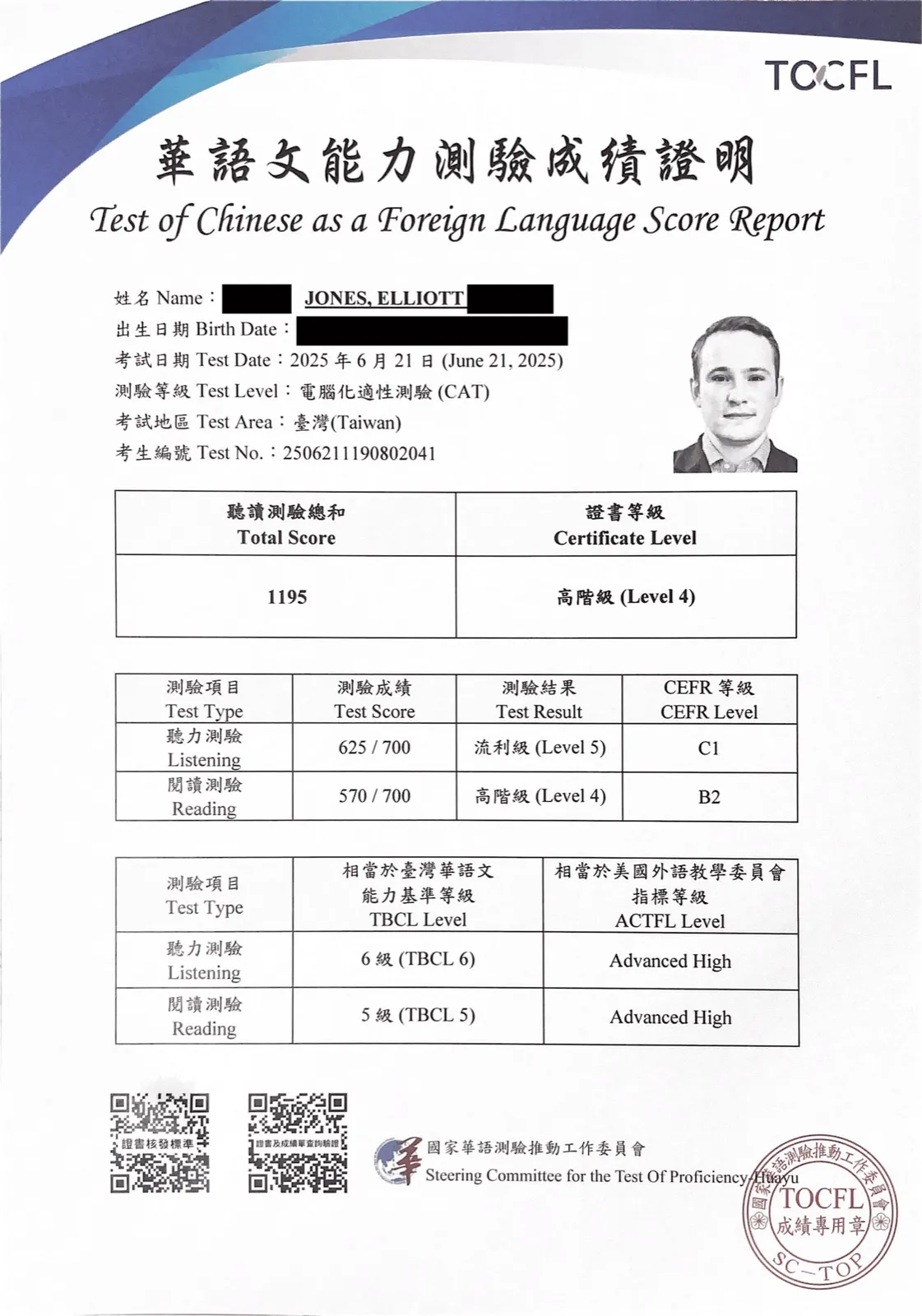

There are two things that are important to mention:
The first is that I only sat the exam once I was already fluent. I studied for its format, and you should: it is a strange test, and knowing its shape is worth real points. But I did not learn Chinese in order to pass it. The certificate is a description of where I had got to, not the reason I got there.
The second is that the speaking score is the one people misread, including me for a while. Speaking is probably my strongest skill. The TOCFL speaking test is unusually hard, and it makes you read your prompts off a screen, so a weak reader loses speaking marks for reasons that have nothing to do with speaking. My reading was the weak link, and it dragged the speaking number down with it.
The three years I wasted
Here is the part these articles usually leave out.
I moved to Taiwan and then sat at a very low level for at least three years. Not a plateau after good progress. A floor. I was living inside the language, hearing it in every shop and on every commute, and I was barely getting better at it.
So when I say Taiwan did most of the work, I mean it, but not in the way it sounds. Being here was necessary. It was nowhere near sufficient. What eventually moved me was two things arriving at roughly the same time, around 2018: I stopped minding that I sounded like an idiot, and I built an actual workflow.
Everything below is downstream of those three wasted years.
1. Start in your ears
About a year before I moved, I started Pimsleur. I never finished it. I do not think I got especially far into it, and I still think it was the right first move.
Audio-only courses give you something a textbook cannot: a mouth that has already made these sounds, and an ear that has already heard them in sentences. By the time I landed I could introduce myself and hold up my end of the first thirty seconds of a conversation. That is not fluency. It is a foundation, and foundations are allowed to be small.
Do not feel obliged to complete it. It is a runway, not a destination.
2. Be willing to look stupid: this is the whole thing
If you take one thing from this article, take this one. It is the difference between my first three years and everything after.
You can hold a conversation with a hundred words. It will be hard work for you and, honestly, hard work for the person you are talking to. They will wait while you assemble a sentence. You will say something slightly wrong and they will understand you anyway. You will occasionally say something that lands as funny when you meant it seriously.
None of that matters. What matters is that the conversation happened, in Chinese, and that you were the one having it.
I spent three years avoiding exactly that discomfort, quietly telling myself I would speak once I was better. You do not get better and then speak. You speak badly for a while, and that is the mechanism.
3. Fish for words with the words you already have
This is the single most productive habit I developed, and it costs nothing.
When I hit a word I did not know, I did not reach for my phone and I did not switch to English. I described my way around it using words I already had. If I wanted “landlord” and did not have it, I said the equivalent of the person who owns the flat I rent.
Nine times out of ten, the person I was talking to would supply the actual word. Unprompted, immediately, and in the exact context I needed it.
That loop does three jobs at once. It keeps the conversation in Chinese. It drills the skill of getting meaning across with incomplete tools, which is most of what fluency actually is. And it hands you new vocabulary already attached to a moment you will remember. A word you fished for yourself sticks in a way a word from a list never does.
Then you save it. Which is the next tip.
4. Capture in the moment, process later
Two tools, two jobs, and keeping them separate is what makes it survivable.
In the wild, I use Pleco. Something comes up: a word I fished out of a conversation, something I need for a task that day, something I want to be able to say to my wife tonight. I look it up and save it there. That is all. Seconds, in the moment, no friction.
At my computer, I use Anki. Later, I go through what I saved and turn it into cards. Then I review daily.
The reason to split them is that card-making is a desk job and life is not. If you try to make good cards on your phone while standing in a shop, you will make bad cards or, more likely, you will stop bothering. Capture cheaply, build properly.
Note what this means about where the words come from: mine came from my own life. My work, my errands, my marriage. Not a frequency list. A pre-made deck teaches you someone else’s vocabulary; the words you fished for yourself are already the ones you need.
5. Make the card match the skill
A card should test one thing, and the front should contain only what that skill actually starts from. Everything else goes on the back.
| Training | Front | Back |
|---|---|---|
| Listening | The audio only | Character, meaning, anything you like |
| Reading | The character only | Audio, meaning, anything you like |
That is the entire rule. If you are training your ears, your ears have to do the work. Seeing the character first means you read it and never listened at all. If you are training reading, the character has to stand alone.
It sounds obvious written down. Most decks I have seen break it.
6. Don’t learn to read yet
I did not start deliberately learning to read until I was already fluent at speaking and listening. That is roughly five years of not reading.
I do not regret it. Two reasons.
First, characters are where most self-teachers stall, and stalling early costs you the thing that actually drives progress: conversations. Speech and listening compound socially. Reading does not; nobody is going to have a chat with you about your character recognition.
Second, and this genuinely surprised me: when I did start, a large part of the foundation was already there. Five years of shop signs, menus, MRT announcements, message threads and product labels had quietly taught me a lot of the highest-frequency characters without a single minute of study. I had been reading by accident the whole time.
Postponing reading is not the same as avoiding it. Living somewhere the writing surrounds you does a slow, free version of the work while you get on with talking.
7. When you do start reading, start humiliatingly low
When I finally went at reading properly, I used Du Chinese and I started at the bottom levels, well below where my speaking was, and worked up to Advanced.
Starting below your level feels like a waste of time for about a week. It is not. Your reading is genuinely a beginner even when your speech is not, and graded material lets the two catch up without you having to grind through a novel with a dictionary in the other hand. Being fluent in speech buys you nothing on the page except speed through the early levels.
On traditional versus simplified: I have never deliberately studied simplified. My simplified reading is clearly worse than my traditional, and it is good enough. If you are in Taiwan, learn traditional and let simplified arrive on its own. It mostly does.
8. Feed your ears once they can take it
Once my listening was at a reasonably high level, I listened to a lot of podcasts, and that is where a good chunk of the last stretch came from.
The order matters. Native-speed audio is close to worthless early on. It is noise you cannot segment, and an hour of it teaches you nothing. But past a certain point it flips, and long-form native audio becomes the most efficient input available, because it is endless, free, and pitched at nobody but adults.
If you are early, do not force this. If you are past the middle, this is probably the highest-yield hour in your day.
9. You probably don’t need to write by hand
This is my one real regret: months spent on a skill I have completely lost.
I learned to handwrite characters. I gave it up, never used what I had learned, and forgot essentially all of it. I work in a Chinese-language environment every day and I cannot remember the last time it would have helped.
Typing is king. Pinyin or zhuyin input means the skill you need is recognition, not production. You type the sound and pick the character. Every hour spent on stroke order is an hour not spent on the thing you will do ten thousand times a day.
Some people enjoy handwriting for its own sake, and that is a completely fine reason to do it. Just do not tell yourself it is a step towards using the language.
10. Learn the sounds, not the numbers
I could not tell you which tone a word takes. Not for common words. Not for words I use every day. Ask me whether 買 is second or third and I will have to say it out loud and guess.
I hear tones. I produce them correctly. I understand which word somebody said, instantly, and tone is doing that work. I have simply never held the numbers in my head, because I acquired the sounds rather than the labels.
The tone drills that dominate self-study advice are teaching a taxonomy. What you actually need is the ability to hear a difference and reproduce it, and the way to get that is volume of audio and people correcting you when you say the wrong thing, which they will, immediately and cheerfully, because a wrong tone often produces a real and unintended word.
Get the sounds into your ears and your mouth. You can live without ever knowing their numbers. I have.
The tool I ended up building
Everything above is a workflow I assembled by hand out of separate parts. Pleco for the lookup, Anki for the review, Du Chinese for reading, and me in the middle carrying things between them. It worked. The joins were just mine to maintain.
So I eventually built the thing I had wanted to exist. It is called Manda Chinese. It runs in the browser, and there are native Windows and macOS builds.
You paste in any Chinese text, Simplified or Traditional, and it becomes an annotated reader: pinyin, a definition, audio and an HSK and TOCFL level on every word. Anything you look up can go straight into spaced repetition, as a flashcard, a cloze or a whole passage. You can bring your own material in by photo, EPUB or subtitle file, which matters more than it sounds, because the fastest way past graded readers is to read the thing you actually wanted to read. It all works offline.
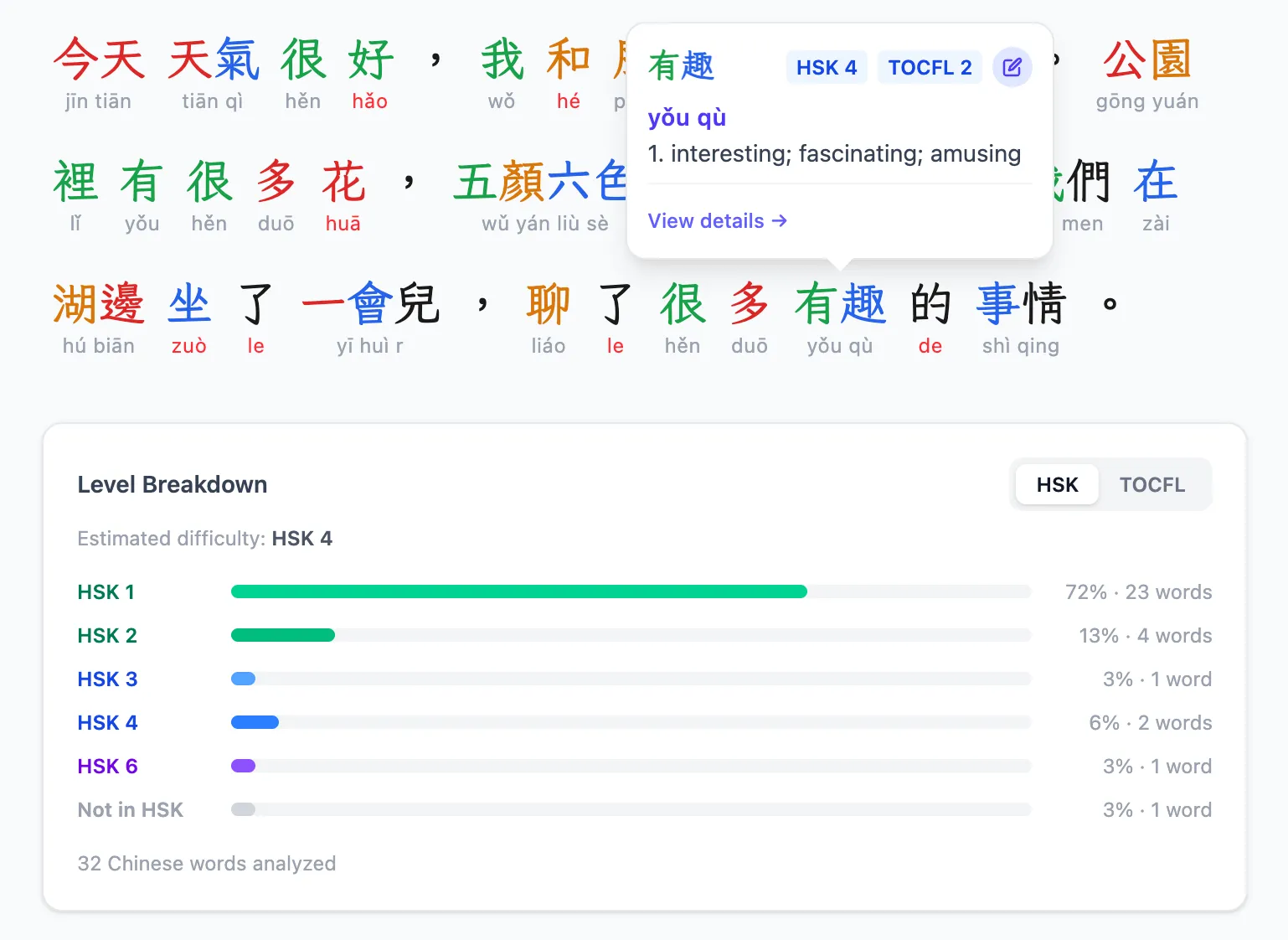
If the last few tips sounded like more admin than you can face, that is the problem it exists to remove. It is at mandachinese.com, and it costs nothing.
If you can’t move to Taiwan or mainland China
I would be lying if I told you the ten things above are the whole story. I have had over a decade of Taiwan and mainland China, a job conducted in Mandarin, and a wife I cannot speak English to. That is an enormous, unearned advantage over someone doing this in the evenings in another country, and no amount of technique closes that gap.
What I will say is this. I had that advantage for three full years and it did almost nothing for me. Immersion is not a method; it is a supply of raw material, and it sits there unused until you are willing to speak badly in front of people and you have a system for keeping what you pick up. Those two things are the parts that were actually mine, and they are the parts that transfer.
The location is the bit you cannot buy, but for me, it was not the bit that was doing the work.
Article views
131 views
View detailsHide details
Article views
131 views
- Last 24 hours
- 5
- Last 30 days
- 38
Top regions
- Taiwan66
- United States22
- United Kingdom11
- Germany6
- Singapore4
- Spain4
- China3
- Brazil2
- France2
- Italy2
Updated 20 Sept 2026, 02:03 · Asia/Taipei